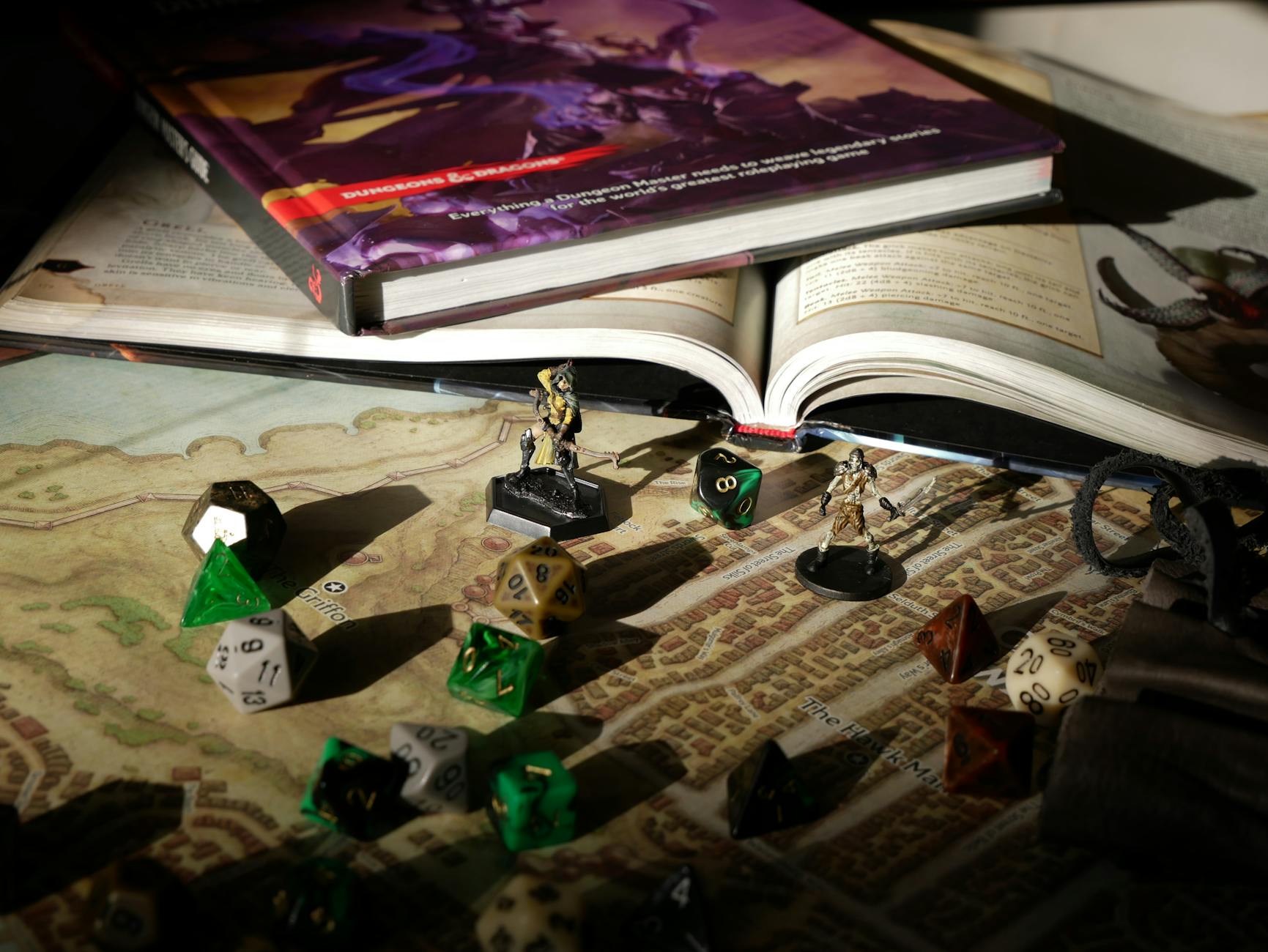
Back in January 2021, I wrote a post called Sorcerers and Snobbery. It was a bit of a rant — part frustrated DM, part bewildered outsider, part person who just wanted to roll some dice with people who weren’t going to make him feel like he hadn’t done the assigned reading. I called out some names. I aired some grievances. And the conclusion I landed on was roughly this: Dungeons and Dragons is a brilliant game being let down by some of the people who play and make it.
Five years on, I’m still playing. Still running games. The Feywild campaign I was so excited about in those posts morphed into something else entirely and then concluded (as campaigns tend to do when you give a group of players enough rope and enough agency to thoroughly hang your carefully-constructed homebrew world). And I’m still asking myself the same question I was asking then, just with a few more grey hairs and a slightly thicker skin:
Is this hobby getting better, or is it just getting louder?
The Boom That Wasn’t (For Everyone)
Let’s not pretend the boom didn’t happen. It absolutely did. Baldur’s Gate 3 became a cultural event. Brandon Sanderson raised over fifteen million dollars on Kickstarter for a TTRPG based on his Cosmere novels. Daggerheart — Critical Role’s own system — landed in 2025 to genuine excitement and a production value that made WotC look like they were still printing rulebooks on a dot-matrix printer.
By the numbers, the hobby is enormous. The global TTRPG market sat at over two billion dollars in 2025. Over three and a half thousand TTRPG-related projects launch on Kickstarter every year, with nearly three-quarters of them getting funded. DriveThruRPG hosts over a hundred thousand individual digital titles.
And yet.
Every time I try to introduce someone new to the hobby — genuinely new, not “I watched some Critical Role” new — I watch the same slow-motion disaster unfold. Their eyes go wide. Not with excitement. With overwhelm. Because before they’ve touched a single d20, they’ve already been told — explicitly or implicitly — that there’s a canon of content they’re supposed to have absorbed. And that’s the hobby’s real problem in 2026. It’s not that it’s too niche. It’s that it has convinced itself that it’s too sophisticated for its own front door.
The Content Curse
Here is my genuine, unhedged take: the TTRPG hobby is a worse place for a brand new player today than it was in 2019. And the reason isn’t the rules. It isn’t the price of books. It isn’t even the fragmentation of the market into a thousand indie systems each promising to be the one that finally cracks the code of collaborative storytelling.
It’s the content. Specifically, it’s the weight of the content. The sheer volume of YouTube channels, Actual Play podcasts, Reddit threads, TikTok hot takes, Substacks, and Discord servers that have grown up around the hobby over the past five years has created an ambient expectation that a new player arrives at the table having consumed at least some of it. And “at least some” is a moving target set entirely by whoever is at that table with the most hours logged.
That’s not unique to DnD — go have a look at Kickstarter’s TTRPG section this month and try to count how many projects describe themselves as taking ‘a fresh new approach to collaborative storytelling’ while simultaneously assuming you already know what a GM screen is, what PbtA means, and why the OGL controversy matters. The indie TTRPG space has its own version of this problem — a rich, creative, genuinely exciting space that has nonetheless developed its own gatekeeping dialect almost as fast as it emerged from mainstream DnD’s shadow.
None of this is a call for new players to catch up. It’s a call for existing players to get out of their own way. The best sessions I’ve ever run (and I’d wager the best sessions most people have ever played in) had almost nothing to do with rule mastery. They had everything to do with giving people permission to tell a story and then getting out of the way while they did it. Mechanics are a framework and the moment a table forgets that, you’ve lost the new player at the door, and frankly, you’ve lost something important about why any of us started doing this in the first place.
Brennan Lee Mulligan Is Not Your Problem (But He Is Your Mirror)
I want to say something nice about Brennan Lee Mulligan, because I mean it sincerely and I don’t want it to get lost in qualifications: the man is extraordinary. What he does behind the GM screen for Dimension 20 is genuinely some of the finest roleplaying craft I’ve ever watched, and his ability to hold narrative threads, honour player choices, and deliver emotionally resonant moments on camera without it ever feeling like performance is a masterclass in how to run a game.
And that is precisely why he’s irrelevant to the new player conversation.
Brennan is advanced class. He’s the PhD thesis. He’s what you aspire to after a decade of confident GMing when you’ve stopped worrying about forgetting the rules for grappling and started thinking about dramatic structure. Watching BLM and thinking “right, that’s what DnD should look like” is like watching a Michelin-starred chef julienne vegetables and concluding that you probably shouldn’t bother learning to cook.
The trouble is that Brennan — and both Critical Role and Dimension 20 by extension — has become something of a new benchmark in the Actual Play ecosystem, and benchmarks have a nasty habit of becoming expectations.
The WotC OGL Hangover
Wizards of the Coast tried to pull a fast one in 2023 with the Open Game Licence controversy, and the hobby caught them in the act. For a few glorious, furious weeks, the community did something genuinely impressive: it organised, it pushed back, and it won. Paizo doubled down on OGL-free licensing with ORC. Third-party publishers scattered to the winds and explored new systems. For a moment, it felt like the industry was going to meaningfully restructure.
And then, largely, it didn’t.
WotC released updated core books with a 62% player approval rate in beta testing — which, if you’re being uncharitable about it, means that nearly four in ten players who tested your flagship product didn’t love it. Pathfinder 2e usage on virtual tabletops bumped up 15% after the OGL disaster, which sounds impressive until you remember that DnD 5e still accounts for over half of all games played on Roll20.
The big dragon didn’t shrink. It just got a stern talking-to and went back to its hoard.
The BG3 goodwill, meanwhile, has all but evaporated for everyone except the genuinely devoted. That game was a cultural supernova (and I say that as someone who played it obsessively) but supernovas don’t sustain ecosystems. They illuminate them briefly and then leave. WotC benefited enormously from Larian’s work without doing anything to particularly deserve that benefit, and they’ve spent the eighteen months since largely squandering the attention it generated.
If I’m being fair, WotC is in a genuinely difficult position. The OGL mess poisoned their relationship with exactly the third-party creators whose content had built much of 5e’s ecosystem, and now those same creators are the ones driving energy behind the likes of Daggerheart and Draw Steel. The very people who built the cathedral have started building their own chapels. And whether WotC can win them back — or whether they need to — is the most interesting structural question in the hobby right now.
My Table, My Kids, My (Ongoing) Chaos
Through all of this industry noise, I’ve managed something I wasn’t sure I’d ever pull off: I have a reasonably consistent group, and I have introduced my kids to the game.
But here’s the thing — and this is the part I come back to when I think about the new player problem — when my kids sit down to play, they don’t care about any of it. They don’t know what Daggerheart is. They haven’t watched Critical Role. They’re not worried about whether they’re playing 5e correctly or whether their character concept is mechanically optimised. They just want to know what happens next. They want to make a choice and see it matter.
That is the game. That has always been the game. Everything else — the books, the discourse, the Kickstarters, the hot takes on system design — is just scaffolding around that one simple, irreducible thing.
So: Boom or Bust?
The boom isn’t over. The numbers are too big, the creative output too significant, and the genuine joy too real for that to be true. But it has matured in ways that aren’t always flattering. The community is larger, louder, and more factionalized than it was in 2019. Like most poles of the internet, the gatekeeping hasn’t disappeared, it’s just wearing different clothes and arguing about different things. The indie renaissance is real and exciting but has brought with it its own brand of “you haven’t heard of this system?” snobbishness that would be funny if it weren’t so familiar.
What gives me hope is what’s actually happening at tables — not on Twitch streams, not in Discord servers, not in the comments of hot-take YouTube videos, but in living rooms and kitchens where somebody sat down with a set of dice and a story they wanted to tell.
My campaign may have wandered somewhere entirely unintended. My kids still argue about who gets to be the princess. The game is fine. It’s the industry around it that needs to look in the mirror.
And maybe that’s always been true.
 This is a Game Blog